
A Balanced Sitting Position
By Jamie Fiste, Professor of Cello at Central Michigan University
Share This
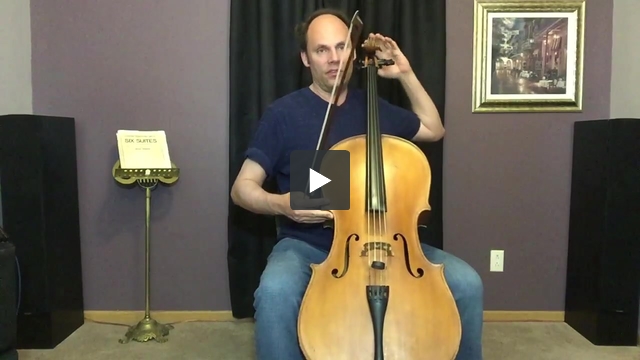
Being physically balanced with a lengthened spine is easy to overlook but is vitally important for a relaxed technique. In fact, it is difficult to overemphasize its importance and needs to be covered before addressing how to
hold the cello. The way we sit does not simply affect our backs, as important as that is - cellists are notoriously prone to back problems - your 'posture' affects your entire body, including your arms and hands.
Cellists need to think of their body as a unified whole with all the parts interconnected and interacting. If we are out of balance, this will have a cascading affect on virtually every other facet of technique. For starters, when unbalanced we must counteract this imbalance through greater use of core and back muscles. When we are balanced, on the other hand, we expend less energy to keep ourselves in position and it frees up our back and core muscles to support our arms in the important job of playing the cello.
Before I continue, I would like to say something about the words 'position' as in 'sitting position' and 'posture'. Position and posture often conjure up ideas of something rigid and inflexible. I generally prefer to use the terms 'balanced' and 'lengthened'. And by 'lengthened' let's be careful not to imagine something rigid as well.
The Bad News: Sitting at 90 Degrees Can Be Bad for the Back
In a study at the Woodend Hospital in Aberdeen, Scotland, researchers found that sitting at a 90 degree angle was detrimental to the back. They concluded that a relaxed position of leaning backwards at 135 degrees was optimal. "Disk movement was most pronounced with a 90-degree upright sitting posture. It was least pronounced with the 135-degree posture, indicating that less strain is placed on the spinal disks and associated muscles and tendons in a more relaxed sitting position" (ScienceDaily, Nov. 27, 2006).
So what does this mean for cellists? It basically means that sitting to play the cello is a necessary evil for us. You need a special chair or your recliner to lean backwards at 135 degrees, besides being impractical for playing the cello.
We can't sit back at 135 degrees but can we keep other principles in mind in our seating position? Absolutely.
Here are some principles we can apply when sitting down to play the cello;
- Respect the natural curve of your spine
- Use a wedge-shape orthopedic cushion and/or cello chair
- Use a chair that is a correct height
- Find and use a balanced position for your body
- Balance your head
- Lengthen your spine
Respect the Natural Curve of the Spine
This may come as a surprise, but one of the least helpful admonitions is to play the cello with a 'straight back'. We have a natural curve to our spinal column that is designed as a built in shock absorber. To straighten it would eliminate its natural shock absorbing tendencies. Straightening the spine also puts undue strain on the muscles and ligaments in the lower back by causing them to stretch. There are three areas to which you should pay particular attention,
- Respect the curve of the spine in the lower back
- Do not "hunch over" while playing the cello
- Respect the curve of the spine around the neck
One way we straighten our lower back is by slouching. We've all done this while working at the computer. Although slouching can sometimes feel as though lower back strain is relieved, the results are actually short lived. In fact, slouching eliminates the natural curve in the lower back and can cause problems down the road. Slouching also makes it more difficult to breath while playing, which can deprive our muscles of oxygen.
We should also avoid hunching over the cello while playing. In a study, Postural Effects During Cello Performance
(Ueno et al.), the researchers found using an electromyogram that in a "bent posture" position the upper back muscles showed increased activity. This was to counteract the motions in the arms in an effort to keep the upper body balanced. The authors state that with good posture we do not need the upper back muscles to keep the upper body in balance and they can be used instead to support the motions from the shoulders to the fingers. This results in a more efficient transmission of power from the back muscles to the arm muscles. Yes, our upper back muscles will assist our arms all the way down to the fingers if we adopt proper posture! Keep that in mind.
Another way we cease to respect the natural curve in our spine is by pushing our neck and head forward. The main culprit is the C peg. What we should rather do is balance our head on our neck (see below).
Use a Wedge-Shape Orthopedic Cushion and/or Cello Chair
It's worth considering buying a wedge-shape orthopedic cushion
and/or a cello chair. The cushion is especially helpful if you are tall and have to regularly contend with chairs that are too low. But the benefits go beyond a proper chair height; the forward slant of the cushion and cello chair tilts your pelvis and lower back forward, which has two main benefits. First, it helps maintain the natural lumbar curve of the lower spine. Also, by tilting your pelvis and lower back forward, you no longer sit at a 90 degree angle to the chair, putting your back into a position that is closer to the 135 degrees mentioned above (open pelvis angle).
I recommend avoiding over the counter orthopedic cushions. They are usually too soft for playing the cello and cause instability. Instead, cello seat cushions are available from Judy Johnson Henderson at celloseatcushions.com. They come in a variety of sizes and are made from a firmer foam to keep you balanced and stabilized while playing.
Don't wait until you experience back problems to take these issues seriously. It is always easier to prevent back problems then fix them once they occur.
Use a Chair that is a Correct Height
Having a correct chair height allows for easy balance and for your thighs to have a slight downward slant (i.e. your knees are slightly below your hips), avoiding the dreaded 90 degree angle while promoting an open pelvis angle and a natural lumbar curve. Sitting in a chair that is too low - when your knees are above your hips - makes it particularly difficult to balance and maintain the lumbar curve in the lower back. Your core muscles will engage just to hold up your upper body, tiring quickly. Slouching is often the result, putting strain on the lower back. Instead, use an orthopedic cushion to raise the chair height.
If the chair is too high when teaching, you can put books under the student's feet.
Balance the Head on the Neck
Try this simple exercise to determine whether your head is balanced on top of your neck. Simply nod you head up and down and find the point where it experiences the greatest freedom of motion. Try sticking your neck out and nodding. It's difficult, isn't it? Find that optimal position for the neck where you can nod easily and use that as your position while playing the cello. Also, position your stand so you can keep your chin parallel to the ground. Make sure that the pegs on the cello do not interfere with your balanced head position. If you like your cello lower then do not let the peg poking you in the neck effect the position of your head.
Placement of Feet While Playing the Cello
If the chair height is correct, the feet should be flat on the floor. This helps stabilize your body and remain in a balanced position. Try this experiment; tuck your feet under your chair and be aware of the muscles in your abdomen. Now, place your feet flat on the floor and compare the feeling. Repeat the experiment. In which position is your abdomen more relaxed? Most likely you will notice your abdomen muscles contracting more when your feet are tucked under your chair. This is because your body is out of balance and your stomach muscles are needed to hold you in position. A more grounded position is to have your feet flat on the floor. As in the case of our back muscles, our core muscles or abdomen muscles can assist our arms to do their work if we adopt a proper sitting position.
A Lengthened Spine
We often hear 'sit up straight' from teachers and parents. As we have seen, straight is to be avoided. Instead, we need a 'lengthened' spine. This can often be achieved indirectly to avoid a rigid position. In my Alexander technique lessons, my teacher had me imagine light beams coming out of the top of my head as well as out my sitting bones. By using imagery such as this, we can achieve a lengthened spine without forcing it.
Try this - find a chair height that is the proper height for you. Keeping your feet flat on the floor, balance your upper body on your two sitting bones. Now balance your head on your spine. Find that sweet spot where barely any effort is needed and your skeletal system is bearing your weight and holding you up. Now close your eyes and imagine light beams coming out the top of your head and out your sitting bones. You may have just grown a couple inches! Well, maybe not that much but you may find you need a slightly longer end pin length after this little exercise.
I wonder how many overuse injuries would be prevented by paying attention to these concepts.
Remember: a balance and lengthened spine.
S.D.G.
Authored by Jamie Fiste, Professor of Cello at Central Michigan University.
A special thank you to Cora Enman, Associate Professor of Voice at Central Michigan University, who sadly passed away a few years ago. She was a body mapping and Alexander Technique specialist. The information she provided me regarding the back and posture was extremely useful in the writing of this article.